
AI-native CRM for the insurance industry
Insurance companies are under pressure from two sides. Customers expect fast answers, simple digital service, and clear communication. At the same time, teams must manage risk, documents, approvals, policy changes, claims, broker networks, and compliance.
This is why many insurers are moving from fragmented tools to an AI-native CRM platform that connects customer data, workflows, and AI agents in one operating environment.
For insurance leaders, the goal is not to “add AI” as a separate feature. The goal is to make sales, service, and operations work faster, with fewer manual steps and better control over every customer journey.
What is an AI-native CRM for insurance?
An AI-native CRM for insurance is a customer relationship and workflow system where AI is built into daily processes from the beginning.
In simple terms, it helps insurance teams:
- manage customer and policy data in one place;
- automate repetitive steps in sales and service;
- support agents, brokers, and back-office teams;
- improve response time for customers;
- reduce manual work in claims, renewals, and requests;
- use AI agents to analyze, suggest, summarize, and route tasks.
Creatio is an agentic CRM and no-code workflow automation platform. It combines CRM, AI agents, and process automation so businesses can build and change workflows without long development cycles.
What does “no-code” mean?
No-code means that business applications and workflows can be configured visually, without writing large amounts of code. This is important for insurance because products, rules, tariffs, and service models often change.
With no-code, an insurer can adapt a process faster: add a new approval step, change a sales pipeline, create a service workflow, or adjust a broker request form.
What does “AI-native” mean?
AI-native means that AI is not an external add-on. It is part of the platform logic.
In practice, AI can help with:
- lead prioritization;
- customer request classification;
- next-best-action suggestions;
- document and case summaries;
- service routing;
- workflow recommendations;
- analysis of repeated issues.
This is especially useful for AI in insurance, where employees work with large volumes of customer interactions, documents, and operational rules.

Why traditional insurance CRM systems no longer meet customer expectations
A traditional CRM can store contacts, policies, and communication history. But storage alone does not solve the main operational problems of insurers.
Customers do not compare their experience only with other insurance companies. They compare it with banks, delivery services, marketplaces, and digital products where information is updated quickly and service is transparent.
A classic CRM insurance setup often becomes limited when:
- sales teams use one system and service teams use another;
- brokers send requests by email or messengers;
- customer data is duplicated across departments;
- claims and policy changes require manual follow-up;
- managers cannot see where processes slow down;
- small changes require too much IT involvement.
This creates a gap between what the customer expects and what the company can deliver.
An AI-native insurance CRM helps close this gap by connecting people, data, and workflows. The system does not just show information. It helps teams act on it.
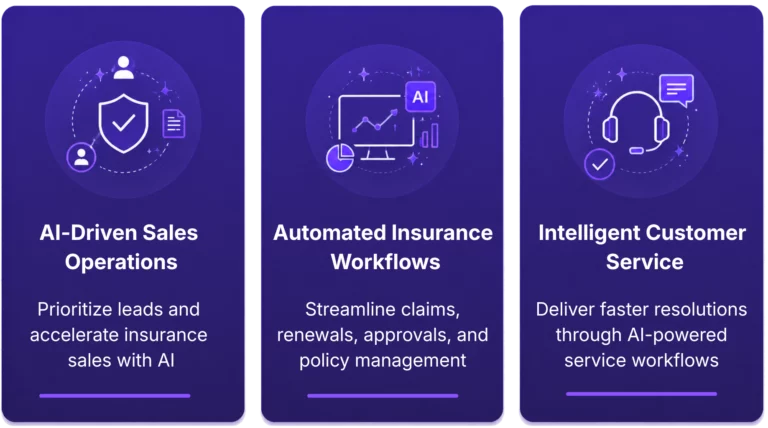
How AI improves insurance sales operations
Insurance sales depend on timing. A lead that is not processed quickly may go to another provider. A renewal that is not followed up on time may be lost. A broker request that waits too long may slow down the whole sales cycle.
AI can support sales teams by helping them focus on the right actions first.
For example, AI-powered insurance CRM software can:
- identify high-priority leads;
- suggest the next step for a manager;
- remind teams about renewals;
- summarize previous communication;
- prepare context before a call;
- help segment customers for cross-sell or upsell campaigns.
For insurance brokers and agencies, an insurance broker CRM can also make work with partners more transparent. It helps track requests, offers, documents, commissions, and communication history in one system.
This does not replace the expertise of brokers or sales managers. It gives them better context and removes routine work that slows them down.
How AI transforms customer service in insurance
Customer service in insurance is often complex. A client may ask about a policy, report an incident, send documents, request a payment update, or need help with renewal terms.
If these requests are handled manually, service quality depends too much on the workload and memory of individual employees.
AI insurance solutions can help service teams process requests faster and more consistently. AI agents can analyze the customer’s message, detect intent, suggest an answer, route the case, or summarize the situation for a specialist.
Creatio Service, for example, supports case handling, service routing, and customer interactions. When combined with AI agents and workflows, it helps create a more predictable service process.
This is useful when a company needs to:
- reduce waiting time;
- avoid lost requests;
- give customers clear status updates;
- support service teams during peak periods;
- keep communication consistent across channels;
- understand repeated service problems.
For the customer, this means fewer repeated explanations. For the business, it means lower operational pressure and better control over service quality.

Why workflow automation is critical for insurers
Insurance is built on processes. A policy sale, claim, renewal, complaint, broker request, or document check is never just one action. It is a chain of steps.
If this chain is managed manually, the company faces delays, errors, and extra costs.
Insurance process automation helps make these steps visible and controlled. Each request moves through a clear workflow. The system can assign tasks, trigger notifications, collect data, update statuses, and escalate cases when deadlines are missed.
Where automation brings value first
Insurance workflow automation is especially useful for:
- lead processing;
- quote preparation;
- policy renewals;
- broker requests;
- customer service cases;
- claims intake;
- document collection;
- approval routing;
- complaint management;
- reporting and analytics.
The business value is practical: fewer manual operations, fewer missed steps, faster response time, and better visibility for managers.
For enterprise insurers, this visibility matters. It helps understand where teams are overloaded, which stages take too long, and which processes need improvement.
How AI-native CRM connects sales, service, and operations
The main weakness of many insurance systems is fragmentation. Sales, service, claims, finance, and broker teams may all have pieces of the same customer story. But no one sees the full picture.
An AI-native CRM connects these areas into one environment.
Creatio CRM supports sales, marketing, service, and operational workflows. Creatio Sales helps manage the sales cycle. Creatio Marketing supports campaigns and personalization. Creatio Service helps organize service operations. Creatio Studio allows companies to build business applications, workflows, and AI agents using no-code tools.
For insurers, this means that one customer profile can connect:
- lead source;
- policy history;
- broker communication;
- service cases;
- claims;
- renewals;
- documents;
- tasks;
- analytics.
This is why CRM for insurance industry should not be seen only as a sales tool. A modern insurance CRM solutions approach should support the full customer lifecycle.
Business scenario: from request to renewal
Imagine a customer sends a request for a new policy through a website.
In a disconnected process, the request may go to email, then to a manager, then to a spreadsheet, then to another department. Each step creates a risk of delay.
In an AI-native CRM, the process can work differently:
- The request is automatically registered in CRM.
- AI analyzes the request and identifies the product type.
- The system assigns the lead to the right manager or broker.
- The customer receives a confirmation.
- The manager sees the full context and suggested next step.
- Documents and approvals move through a workflow.
- After policy activation, the system schedules renewal reminders.
- Marketing and service teams receive relevant customer data for future communication.
This is how insurance agents software becomes more than a tool for individual employees. It becomes part of the company’s operating model.

How Banza works with Creatio
Banza is a TOP partner of Creatio and a Global System Integrator 5th level since 2018. We design and implement no-code, AI-driven CRM and workflow automation solutions for enterprise clients.
Our role is to help companies turn Creatio into a working business system, not just install a platform.
We support clients with:
- process analysis;
- CRM and workflow design;
- no-code configuration;
- AI agent implementation;
- integrations with existing systems;
- data migration planning;
- user adoption;
- support after launch.
Banza has experience across banking, insurance-related processes, telecom, retail, manufacturing, logistics, and customer service automation. This cross-industry expertise is important because many insurance challenges are not only about policies. They are about process discipline, service speed, operational transparency, and scalable customer communication.
What businesses should expect from AI-native CRM
AI-native CRM is not a quick cosmetic upgrade. It changes how the company manages work.
The strongest results usually come when a business starts with specific operational questions:
| Business question | What AI-native CRM can help with |
| Why do we lose leads? | Lead tracking, prioritization, follow-up automation |
| Why do service requests take too long? | Case routing, AI summaries, SLA control |
| Why do managers repeat manual tasks? | Workflow automation and no-code process design |
| Why is reporting incomplete? | Unified data and process visibility |
| Why is it hard to scale broker operations? | Broker workflows, request tracking, document control |
This approach keeps the project practical. The company does not automate for the sake of technology. It automates the processes that affect revenue, cost, and customer experience.
Why fast time-to-market matters
Insurance companies cannot wait years to modernize operations. Market conditions, customer expectations, and regulatory requirements change too quickly.
No-code tools and ready-made expertise help reduce time-to-market. Banza focuses on flexible and scalable solutions that can be adapted to the client’s existing processes and growth plans.
This is valuable for companies that need to launch changes faster without building a large internal IT team for every process improvement.
When an insurer should consider AI-native CRM
An insurance company, broker network, or agency should consider AI-native CRM if it faces at least several of these problems:
- customer requests are processed too slowly;
- teams work in different systems;
- managers lack a 360-degree customer view;
- renewals are not controlled systematically;
- brokers and agents need better tools;
- service quality depends too much on manual work;
- claims or requests are difficult to track;
- IT teams are overloaded with small changes;
- reporting does not show the real process picture.
In these cases, AI-native CRM can become a foundation for controlled growth.
Final thoughts
AI-native CRM for insurance is not only about artificial intelligence. It is about building a connected system where sales, service, and operations work together.
For insurers, brokers, and agencies, this means faster processes, better customer experience, lower manual workload, and more transparent management.
Banza helps businesses stay competitive with no-code, AI-driven CRM and workflow automation solutions built around real business processes. To stay competitive in a changing insurance market, companies need flexible CRM and workflow automation. Banza helps businesses design and implement Creatio-based solutions that support real processes, reduce manual work, and improve customer experience.