

Creatio AI Agents for Financial Services Operations and Compliance Workflows
Financial institutions are under increasing pressure to improve operational efficiency while meeting strict regulatory requirements. Traditional automation can streamline repetitive tasks, but modern financial organizations need systems that understand context, make intelligent decisions, and collaborate with employees across complex processes.
This is where AI agents for financial services are transforming the industry. Unlike conventional automation or standalone AI assistants, AI agents can analyze information, trigger workflows, coordinate tasks across departments, and continuously support employees throughout business processes.
Platforms such as Creatio, an agentic CRM and no-code workflow automation platform, enable financial institutions to deploy AI agents that improve customer service, accelerate operations, strengthen compliance, and reduce manual work without extensive software development.
What Are AI Agents in Financial Services?
AI agents in financial services are intelligent software entities that can understand business context, make decisions within defined rules, and execute multi-step workflows alongside human employees.
| Technology | Primary role | Example |
| Traditional automation | Executes predefined rules | Automatically routes a loan application |
| AI assistant | Provides information or recommendations | Answers an employee’s question about internal policies |
| AI agent | Understands context, takes actions, collaborates with people, and manages workflow execution | Reviews customer documents, requests missing information, escalates exceptions, and prepares compliance records |
Rather than replacing employees, AI agents help them complete work faster and with greater accuracy. Human specialists remain responsible for strategic decisions, while AI handles repetitive, data-intensive, and operational activities.
As a result, AI in financial services becomes a practical productivity tool rather than simply another chatbot.
Why Financial Institutions Are Adopting AI Agents
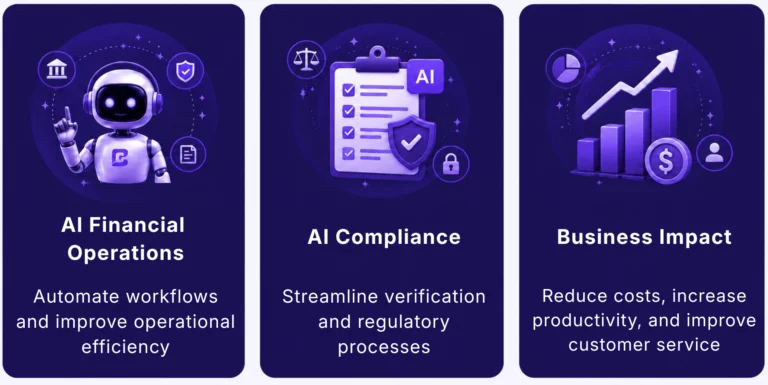
Financial organizations adopt AI agents because they reduce operational costs while improving speed, accuracy, and regulatory compliance.
Banks, insurance companies, lenders, and investment firms process thousands of customer interactions and internal requests every day. Many of these activities involve repetitive manual work that delays service delivery and increases operational risk.
Common business drivers include:
- faster customer onboarding;
- automated document verification;
- intelligent case routing;
- fraud and anomaly detection;
- regulatory reporting;
- customer service optimization;
- internal workflow coordination;
- knowledge retrieval for employees.
Instead of adding more manual reviews, organizations increasingly invest in financial services automation powered by AI agents that can operate across multiple systems while keeping employees involved in decision-making.
Industry research also indicates growing enterprise adoption of AI-native business platforms that combine workflow automation with AI capabilities instead of implementing isolated AI tools.

How Creatio AI Agents Work
Creatio AI enables organizations to embed AI agents directly into CRM and operational workflows without extensive coding.
Creatio is an AI-native CRM and no-code workflow automation platform that combines CRM, workflow orchestration, and AI agents within a single environment.
Instead of functioning as standalone assistants, Creatio AI agents work inside real business processes.
For example, an AI agent can:
- receive a customer request;
- analyze submitted documents;
- identify missing information;
- trigger additional verification;
- route the request to the correct specialist;
- generate summaries for employees;
- prepare audit-ready documentation.
Because everything happens inside one workflow platform, organizations maintain governance, transparency, and human oversight throughout the process.
This approach makes Creatio AI particularly valuable for highly regulated industries where every decision requires traceability.
Financial Services Workflows That AI Agents Can Automate
AI agents can automate operational workflows across nearly every department in a financial institution.
Typical examples include:
Customer onboarding
- identity verification;
- document validation;
- KYC support;
- application completeness checks.
Loan operations
- collecting supporting documentation;
- application pre-screening;
- internal approvals;
- workflow routing.
Customer service
- intelligent request classification;
- ticket prioritization;
- response recommendations;
- service case summaries.
Sales and relationship management
- opportunity qualification;
- meeting preparation;
- customer insights;
- follow-up recommendations.
Internal operations
- policy search;
- employee knowledge assistance;
- workflow monitoring;
- approval coordination.
Instead of automating isolated tasks, AI agents orchestrate complete business processes across departments.
AI Agents for Compliance and Regulatory Workflows
Regulatory compliance remains one of the most resource-intensive functions in financial services. Employees spend countless hours reviewing documentation, validating customer information, routing cases, and preparing evidence for internal or external audits. AI agents help automate these activities while ensuring that human experts remain responsible for final decisions.
Practical compliance scenarios include:
- Document verification. AI agents review uploaded files, identify missing information, compare data across documents, and flag inconsistencies before the case reaches a compliance specialist.
- Intelligent request routing. Incoming compliance requests are automatically categorized and assigned to the appropriate team based on business rules, urgency, and risk level.
- Anomaly detection. AI agents continuously analyze transactions, workflow patterns, and operational data to identify unusual activity that may require additional investigation.
- Audit preparation. Every workflow step is documented automatically, allowing organizations to generate structured audit trails, collect supporting evidence, and prepare regulatory reports more efficiently.
Unlike traditional automation, AI agents can understand business context and adapt their actions within predefined governance rules. They support compliance teams by reducing repetitive work rather than replacing professional judgment.

Benefits of AI Agents for Financial Institutions
AI agents help financial organizations increase efficiency, improve customer experience, and strengthen compliance without sacrificing governance.
Organizations implementing AI agents for financial services typically benefit from:
- shorter processing times for customer requests;
- fewer manual errors;
- improved employee productivity;
- consistent execution of business processes;
- enhanced regulatory compliance;
- faster response to customer inquiries;
- greater visibility across operational workflows;
- improved scalability without proportional increases in staffing.
Another important advantage is collaboration. AI agents work together with relationship managers, compliance officers, service representatives, and operations teams, allowing employees to focus on complex customer interactions and strategic decision-making.
When implemented within an agentic CRM, AI capabilities become part of everyday operations instead of existing as isolated productivity tools.
Challenges and Best Practices for AI Adoption
Successful AI adoption depends on combining technology with governance, well-designed processes, and human oversight.
Despite the growing adoption of AI in financial services, many organizations struggle because they treat AI as a standalone project rather than part of broader digital transformation.
Common challenges include:
- disconnected legacy systems;
- poor data quality;
- lack of workflow standardization;
- insufficient governance;
- unclear responsibilities between AI and employees;
- resistance to organizational change.
Financial institutions can reduce implementation risks by following several best practices:
- start with high-value operational processes;
- clearly define where AI agents can make autonomous decisions and where human approval is required;
- integrate AI directly into business workflows instead of deploying isolated tools;
- continuously monitor AI performance and compliance outcomes;
- use no-code technologies to accelerate improvements without depending entirely on IT teams.
Working with an experienced implementation partner also helps organizations design AI solutions that align with regulatory requirements and existing business processes.
At Banza, we help financial institutions implement AI-driven workflow automation on the Creatio platform, combining industry expertise with practical experience in banking process optimization, CRM implementation, and intelligent automation.

Why Agentic CRM Is the Future of Financial Services
Agentic CRM represents the next evolution of CRM by combining customer management, workflow automation, and AI agents into a single intelligent platform.
Traditional CRM systems primarily store customer information and support sales activities. Modern financial organizations require much more—they need platforms that actively participate in business operations.
An agentic CRM enables AI agents to:
- coordinate customer interactions;
- automate operational workflows;
- support compliance activities;
- recommend next best actions;
- collaborate with employees across departments;
- continuously improve business efficiency.
This approach allows banks and financial institutions to move beyond simple task automation toward intelligent business orchestration.
As AI capabilities continue to evolve, organizations that adopt AI-native platforms will be better positioned to improve customer experience, reduce operational costs, and respond more quickly to changing regulatory requirements.
Conclusion
AI agents are becoming a core component of modern financial services operations—not because they replace people, but because they enable people to work more efficiently.
Unlike traditional automation or standalone AI assistants, AI agents understand business context, execute multi-step workflows, and collaborate with employees throughout operational processes. When embedded into an AI-native CRM and workflow automation platform like Creatio AI, they help financial institutions modernize customer service, streamline operations, and strengthen regulatory compliance.
Whether automating onboarding, document verification, compliance reviews, or service workflows, AI agents create measurable business value while maintaining transparency and human oversight.
If your organization is exploring banking workflow automation or broader financial services automation, Banza can help design and implement intelligent solutions on the Creatio platform that align with your business goals, regulatory requirements, and digital transformation strategy.