

Creatio AI-native CRM: How to Turn Your System into a Revenue Engine
Modern CRM systems are no longer just tools for managing customer data − they are expected to drive revenue, automate decisions, and orchestrate end-to-end business processes. Yet, many companies still rely on legacy systems that capture information but fail to turn it into action.
This gap between data and execution is where AI-native CRM emerges as a new standard, transforming CRM from a passive system of record into an active revenue engine that continuously optimizes sales, marketing, and service performance. Platforms such as Creatio CRM are built specifically to bridge this gap by embedding AI directly into workflows and decision-making processes.
Why traditional CRM systems no longer drive growth?
Traditional CRM systems no longer drive growth because they were built to store data, not to execute processes or generate outcomes. As business environments become faster and more complex, this limitation becomes a critical bottleneck.
The main reasons behind this shift:
- CRM acts as a system of record, not a system of action;
- lack of embedded intelligence limits the value of CRM and AI integration;
- heavy reliance on manual data input and analysis;
- fragmented workflows across sales, marketing, and service teams;
- slow response to customer behavior and market signals;
- limited ability to scale operations without increasing headcount.
Insight: The problem with traditional CRM is not that it lacks data − it lacks the ability to act on it in real time.
What is an AI-native CRM?
An AI-native CRM is a system where artificial intelligence is embedded at the core of how processes are executed, not added as a separate layer, as seen in platforms like Creatio CRM.
Unlike traditional solutions, an AI CRM system continuously analyzes data, automates decisions, and orchestrates workflows across sales, marketing, and service in real time. This transforms CRM from a passive data repository into an active system of execution, where insights, actions, and outcomes are tightly connected within a single operational environment.

From CRM to revenue engine: what actually changes
The shift from a traditional CRM to a revenue engine is not about adding more features − it’s about changing how value is created from data. Instead of storing information and relying on manual execution, an AI-powered CRM such as Creatio CRM actively drives outcomes by turning insights into actions across the entire customer lifecycle.
What actually changes:
- data is no longer static − it continuously generates insights and recommendations;
- decision-making shifts from manual to automated through AI in CRM systems;
- workflows become proactive, not reactive, driven by real-time signals;
- sales teams focus on high-impact opportunities instead of administrative tasks;
- marketing adapts campaigns dynamically based on behavior and performance;
- service operations resolve issues faster through intelligent routing and automation;
- processes are connected end-to-end, enabling consistent execution across departments.
Insight: Most companies try to turn CRM into a revenue engine by adding more data and dashboards, but this rarely changes outcomes. Real impact comes when systems start making decisions and triggering actions automatically, reducing dependency on manual execution and enabling consistent performance at scale.
How AI transforms core CRM processes?
AI does not simply optimize individual tasks within CRM − it reshapes how core processes are executed across the entire customer lifecycle. By embedding intelligence into workflows, an AI CRM system such as Creatio CRM enables real-time decision-making, automation of routine actions, and continuous optimization of outcomes across sales, marketing, and service. Instead of relying on manual coordination, processes become adaptive, data-driven, and consistently executed at scale.
Below are the key ways AI transforms core CRM processes and turns them into measurable drivers of revenue and efficiency.
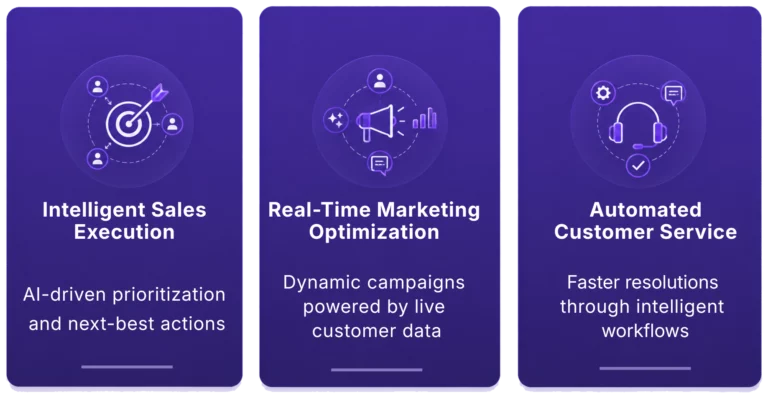
Smarter sales with AI-driven automation
Sales performance is no longer limited by pipeline size, but by how effectively teams prioritize and act on opportunities. With AI sales automation, CRM systems can analyze deal data, predict outcomes, and recommend next-best actions in real time. This allows sales teams to focus on high-value deals, reduce time spent on administrative work, and shorten sales cycles − directly increasing conversion rates and revenue per rep.
Marketing that adapts in real time
Traditional marketing relies on static campaigns and delayed analytics, which limits responsiveness to customer behavior. An AI CRM enables real-time segmentation, personalized messaging, and continuous campaign optimization based on live data. As a result, marketing teams can increase engagement, improve lead quality, and allocate budget more effectively, turning campaigns into dynamic systems that directly contribute to pipeline growth.
Service that scales without growing teams
Customer service often becomes a cost center as demand increases, requiring more agents to maintain response times and quality. With an AI-powered CRM, service processes are automated through intelligent routing, response suggestions, and proactive issue resolution. This allows companies to handle higher volumes of requests without expanding teams, improving response speed, customer satisfaction, and overall operational efficiency.
Workflow automation across departments
Disconnected processes between sales, marketing, and service create delays, errors, and lost opportunities. AI enables end-to-end automation by connecting workflows and triggering actions across departments based on real-time data. Through CRM automation tools, organizations can ensure consistent execution, reduce manual handoffs, and align teams around shared processes − increasing overall efficiency and enabling scalable growth.
End-to-end process orchestration across the customer lifecycle
In many organizations, processes break at the boundaries between departments, where data is lost and execution slows down. AI-native CRM connects these steps into a single, continuous flow, ensuring that every action − from lead generation to post-sale service − is coordinated and data-driven. Through CRM data integration, systems share context in real time, enabling seamless transitions between teams, reducing friction, and maximizing lifetime customer value.

Why CRM integration is the foundation of AI?
AI can only deliver value when it operates on complete, connected, and real-time data. Without integration, CRM remains isolated from critical systems such as marketing platforms, support tools, and financial data − limiting the accuracy of insights and the effectiveness of automation.
The key reasons why integration is essential:
- fragmented data reduces the quality of AI-driven decisions;
- disconnected systems prevent end-to-end process execution;
- delayed data updates limit real-time responsiveness;
- manual data transfer increases errors and operational costs;
- lack of context weakens personalization and recommendations.
A robust CRM integration platform ensures that all systems work as a unified environment, enabling AI to access consistent data, trigger actions across workflows, and continuously improve outcomes.
Insight: Integration is not just about connecting systems − it defines how quickly a business can react to change. Companies with unified data environments can move from delayed analysis to real-time execution, while those without integration remain limited to reactive decision-making, regardless of how advanced their AI tools are.
What makes Creatio an AI-native CRM platform?
Not all CRM systems that include AI can be considered truly AI-native. The difference lies in how deeply intelligence is embedded into processes and how effectively it drives execution across the business.
Creatio CRM represents an example of an AI-native CRM where AI is not an add-on, but a core component of how workflows, decisions, and interactions are managed. The platform combines AI-driven automation, no-code flexibility, and unified process orchestration, allowing businesses to design, execute, and optimize workflows without heavy development cycles. This makes Creatio CRM particularly effective for organizations looking to scale operations while maintaining agility and control over their processes.
Key capabilities that define this approach:
- AI agents embedded directly into workflows, enabling real-time decision-making and task execution;
- unified platform for sales, marketing, and service, supporting end-to-end process orchestration;
- no-code environment that allows rapid adaptation of processes without development cycles;
- continuous optimization of customer interactions based on behavior and data signals;
- seamless CRM data integration across systems, ensuring consistent and actionable insights;
- flexible CRM automation tools that support both structured workflows and dynamic, AI-driven execution.
For example, a B2B services company managing complex, multi-stage sales processes implemented this approach with Creatio CRM to unify workflows and embed AI into daily operations. By automating lead prioritization, standardizing deal execution, and enabling real-time recommendations, they reduced process execution time by 35%, increased conversion rates by 23%, and lowered operational costs by minimizing manual coordination across teams.
As a result, the company was able to handle a higher volume of deals without expanding the team, turning CRM from a support tool into a consistent driver of revenue growth.

Real-world impact: how AI CRM drives revenue growth
The impact of an AI CRM becomes visible not in features, but in measurable improvements across revenue-driving processes. By embedding intelligence into daily operations, companies move from reactive execution to systems that continuously optimize performance across the entire customer lifecycle.
Typical business outcomes include:
- shorter sales cycles due to automated prioritization and next-best actions;
- higher conversion rates through data-driven decision-making;
- increased revenue per customer via cross-sell and upsell recommendations;
- reduced operational costs by minimizing manual work and coordination;
- improved forecast accuracy based on real-time pipeline insights.
Here is a case from our experience. A B2B company with a complex sales process and multiple approval layers implemented an AI CRM system based on Creatio CRM to unify workflows and embed AI into execution. By automating lead qualification, deal prioritization, and follow-ups, they reduced sales cycle time by 34% and increased conversion rates by 26%. At the same time, integrating sales and service data enabled AI to identify expansion opportunities, resulting in 19% growth in upsell revenue.
Implementing an AI-native CRM like Creatio CRM requires proper alignment between processes, data, and system architecture. Our team integrates and customizes Creatio CRM, helping companies connect systems, automate workflows, and embed AI into daily operations. If you are considering implementing Creatio CRM, feel free to contact us to discuss your case.
Common mistakes when implementing AI in CRM
Implementing AI in CRM systems often fails not because of technology limitations, but because of how organizations approach transformation. Many companies expect quick results from AI without addressing the underlying processes and data structure required for it to work effectively.
The most common mistakes include:
- treating AI as an add-on instead of embedding it into core workflows;
- implementing tools without aligning them to business processes and outcomes;
- poor data quality and lack of structured CRM data integration;
- trying to automate inefficient or broken processes instead of redesigning them;
- lack of clear ownership and adoption across teams;
- focusing on features rather than measurable business impact.
To deliver real value, AI in CRM must be implemented as part of a broader transformation − where processes, data, and execution are aligned to support scalable and consistent revenue growth. This also defines how to use AI in CRM effectively: not as isolated tools, but as an integrated system that drives decisions, automates workflows, and continuously improves business outcomes.
Drive Revenue Growth with AI-native CRM
Automate workflows, improve decision-making, and connect sales, marketing, and service processes in one intelligent ecosystem
Request a demo