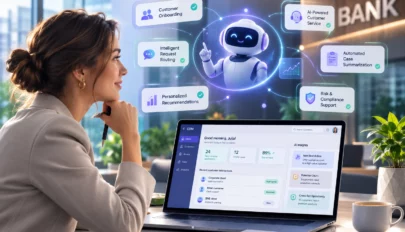

How AI Improves Sales, Marketing, and Customer Service in Enterprise
Enterprise growth is no longer limited by market demand, but by how efficiently teams, systems, and processes operate together. As sales, marketing, and customer service workflows become more complex, many companies struggle with fragmented tools, manual coordination, delayed decision-making, and inconsistent customer interactions.
This is why AI in enterprise is shifting from isolated tools toward connected CRM systems, workflow automation, and cross-functional operations. Instead of using standalone AI solutions, companies are integrating AI into a unified execution layer that improves operational speed, scalability, and real-time collaboration across the business.
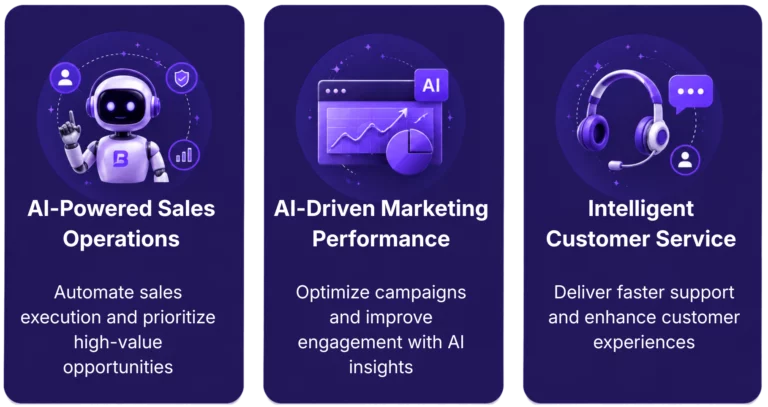
Why AI is shifting from isolated tools to connected enterprise workflows
Many enterprises initially adopted AI for businesses through standalone tools for individual tasks such as content generation, chatbots, or analytics. However, as operations become more complex, disconnected AI systems often create additional fragmentation instead of improving execution across departments.
Today, the most effective uses of AI in business are connected directly to workflows, CRM systems, and operational decision-making.
The main reasons behind this shift include:
- growing operational complexity across sales, marketing, and customer service teams;
- fragmented data stored across CRM, ERP, communication, and support systems;
- manual coordination between departments that slows down execution;
- limited visibility into workflows, approvals, and customer interactions;
- increasing pressure to scale operations without expanding headcount;
- the need for real-time decision-making instead of delayed reporting;
- rising customer expectations for faster and more personalized interactions.
Insight: Most enterprises do not struggle because they lack AI tools. The bigger challenge is that workflows, systems, and teams still operate separately, creating delays and inconsistencies across the business. This is why enterprise AI solutions are increasingly focused on connected execution and workflow orchestration. At the same time, AI in business processes is becoming a critical part of scalable enterprise operations.
How AI improves enterprise sales operations
As enterprise sales processes become more complex, teams often struggle with delayed approvals, fragmented customer data, manual follow-ups, and inconsistent pipeline visibility. AI helps enterprises reduce operational friction by automating execution across CRM systems, sales workflows, and cross-functional coordination.
AI improves enterprise sales operations through:
- automated lead qualification and prioritization based on customer behavior, deal history, and engagement signals;
- AI sales automation that reduces manual administrative work and accelerates pipeline progression;
- real-time recommendations for next-best actions, cross-sell opportunities, and follow-up timing;
- automated proposal generation, document validation, and approval routing within CRM workflows;
- predictive forecasting that helps sales teams identify risks, bottlenecks, and high-probability deals earlier;
- centralized visibility into sales activities, customer interactions, and deal status across departments;
- faster coordination between sales, finance, legal, and customer service teams during complex deal cycles.
Instead of relying on manual coordination, enterprises are increasingly embedding AI directly into sales execution workflows. This allows teams to shorten sales cycles, improve conversion consistency, and scale operations without increasing administrative overhead.
Astana Motors’ case demonstrates how AI can improve enterprise sales coordination and execution within high-volume automotive operations. By integrating AI into CRM workflows, request routing, and communication processes, the company reduced delays in handling customer inquiries, accelerated internal coordination between departments, and automated large volumes of operational requests. This approach helped sales and service teams work within a more connected operational environment, improving response consistency, pipeline visibility, and overall execution speed across the business.

How AI transforms enterprise marketing
Enterprise marketing teams often operate across multiple channels, platforms, and customer segments, making campaign execution difficult to coordinate at scale. AI helps marketing teams reduce manual campaign management, improve personalization, and respond to customer behavior in real time.
AI transforms enterprise marketing through:
- AI marketing automation that adapts campaigns dynamically based on customer interactions, engagement patterns, and funnel behavior;
- real-time audience segmentation across CRM, website, email, and advertising platforms;
- automated content generation and personalization for omnichannel communication;
- predictive lead scoring that helps marketing and sales teams prioritize high-conversion opportunities;
- automated campaign performance analysis with recommendations for budget allocation and channel optimization;
- faster alignment between marketing and sales teams through shared customer data and synchronized workflows;
- AI-driven identification of customer intent, buying signals, and engagement trends across digital channels.
Today, AI for sales and marketing is becoming less focused on isolated campaign tools and more focused on connected execution across the entire customer journey. This allows enterprises to improve lead quality, accelerate conversion, and maintain consistent customer experiences across channels and teams.
How AI improves customer service and post-sales experience
As enterprises scale, customer service teams often face growing ticket volumes, fragmented communication channels, and slower response times across support operations. AI in customer service helps companies improve service consistency, reduce manual workload, and maintain faster customer interactions without continuously expanding support teams.
AI improves customer service and post-sales operations through:
- automated ticket classification, routing, and prioritization across support channels;
- real-time recommendations, knowledge base suggestions, and automated response generation for support agents;
- proactive issue detection based on customer behavior, SLA risks, and service history;
- centralized visibility into customer interactions across email, chat, CRM, and contact center systems;
- automated escalation workflows that reduce delays between support, technical, and account management teams;
- sentiment analysis that helps teams identify dissatisfied customers and reduce churn risks earlier;
- unified customer history that improves continuity between support and post-sales teams.
Astana Motors’ case is a practical example of how enterprise AI automation can improve operational efficiency across large automotive businesses. By implementing configurable AI workflows for call transcription, document verification, request processing, and CRM automation, the company achieved 98% call processing coverage, reduced manual work for legal teams by 50%, and accelerated request and email handling by 70%. The project demonstrates how scalable AI automation helps reduce operational bottlenecks, improve service coordination, and give enterprise teams greater control over business processes without increasing administrative workload.

The role of AI-native CRM in enterprise automation
Many enterprises already use CRM platforms, but disconnected workflows, fragmented customer data, and manual coordination still limit operational efficiency. Banza integrates AI-native CRM Creatio, enabling organizations to unify sales, marketing, customer service, and internal business workflows within a single intelligent platform. This approach helps companies centralize operations, improve process visibility, and accelerate enterprise automation through connected AI-driven workflows.
An AI-native CRM improves enterprise automation through:
- unified customer and operational data across sales, marketing, and service teams;
- real-time workflow orchestration between CRM, ERP, support, and communication systems;
- automated task creation, routing, approvals, and SLA management inside business processes;
- AI-driven recommendations that support faster decision-making and next-best actions;
- centralized visibility into customer interactions, operational bottlenecks, and process performance;
- no-code workflow adaptation that allows enterprises to scale automation faster;
- reduced dependency on manual coordination between departments and systems.
Insight: Many enterprises already use AI across different departments, but isolated automation rarely improves operational scalability on its own. The real business impact appears when AI becomes part of a connected CRM and workflow ecosystem, where data, decisions, and execution operate within a unified environment.
What results enterprises achieve with AI-powered operations
As enterprises integrate AI into CRM systems, workflow automation, and operational coordination, the impact becomes visible not only in productivity metrics, but also in scalability, execution speed, and customer experience consistency. Instead of optimizing isolated tasks, enterprises are restructuring how teams, systems, and business processes operate together.
The most common business outcomes include:
- shorter sales cycles due to faster approvals, lead prioritization, and automated follow-ups;
- reduced operational costs by minimizing repetitive manual work across departments;
- improved collaboration between sales, marketing, customer service, and operations teams;
- faster response times across customer communication and support workflows;
- higher visibility into workflows, bottlenecks, and process performance;
- more accurate forecasting and real-time operational decision-making;
- increased capacity to scale operations without expanding administrative overhead;
- more consistent customer experiences across sales, onboarding, and post-sales interactions.
The advantages of AI in business become most visible when enterprises use AI as part of connected operational execution rather than isolated automation tools. This is also redefining the artificial intelligence impact on business, shifting the focus from individual productivity gains toward scalable enterprise coordination, workflow efficiency, and real-time operational adaptability.
Companies that successfully scale AI operations move beyond isolated automation and build connected execution environments across CRM systems, workflows, and customer operations. With Banza Enterprise AI Agents, businesses can automate approvals, customer communication, and operational routing inside a unified workflow ecosystem. See how enterprises use AI agents and CRM automation to scale sales, service, and operations.
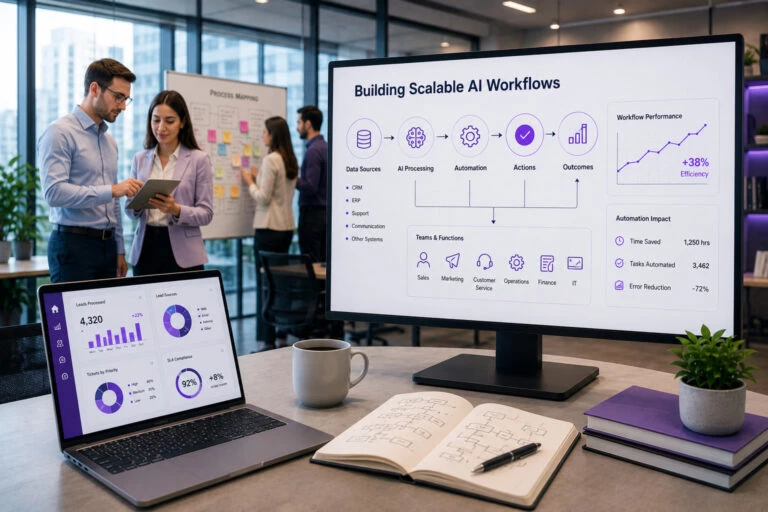
How enterprises can build scalable AI workflows
Building scalable AI workflows requires more than deploying standalone AI tools. Enterprises need structured operational logic, integrated systems, and clearly defined processes where AI supports execution across departments in real time.
At Banza, we help companies build scalable AI workflows by integrating AI into CRM, communication, support, and operational systems to automate high-volume processes, improve coordination, and increase operational efficiency across the business.
To build scalable AI workflows, enterprises should:
- map operational dependencies between sales, marketing, customer service, and internal teams;
- identify repetitive decision points that slow down execution or require excessive manual involvement;
- connect CRM, ERP, communication, and support systems into a shared operational environment;
- define workflow rules, approval logic, and escalation paths before automating processes;
- embed AI into high-volume operational scenarios such as lead qualification, ticket routing, and SLA monitoring;
- continuously analyze workflow performance and optimize automation based on operational data;
- scale AI gradually by starting with high-impact use cases instead of automating all processes simultaneously.
In many organizations, AI is still treated as a standalone productivity tool rather than part of operational execution. However, how is AI used in business is rapidly changing as enterprises move toward connected workflows, integrated systems, and real-time process orchestration. The most scalable results come from embedding AI into enterprise operations where systems, teams, and execution processes work within a unified environment.
Improve enterprise performance with AI automation through connected CRM workflows, real-time automation, and AI-driven operational execution. Request a demo to see how Banza helps enterprises automate sales, customer service, approvals, and cross-functional processes inside a unified operational environment.