
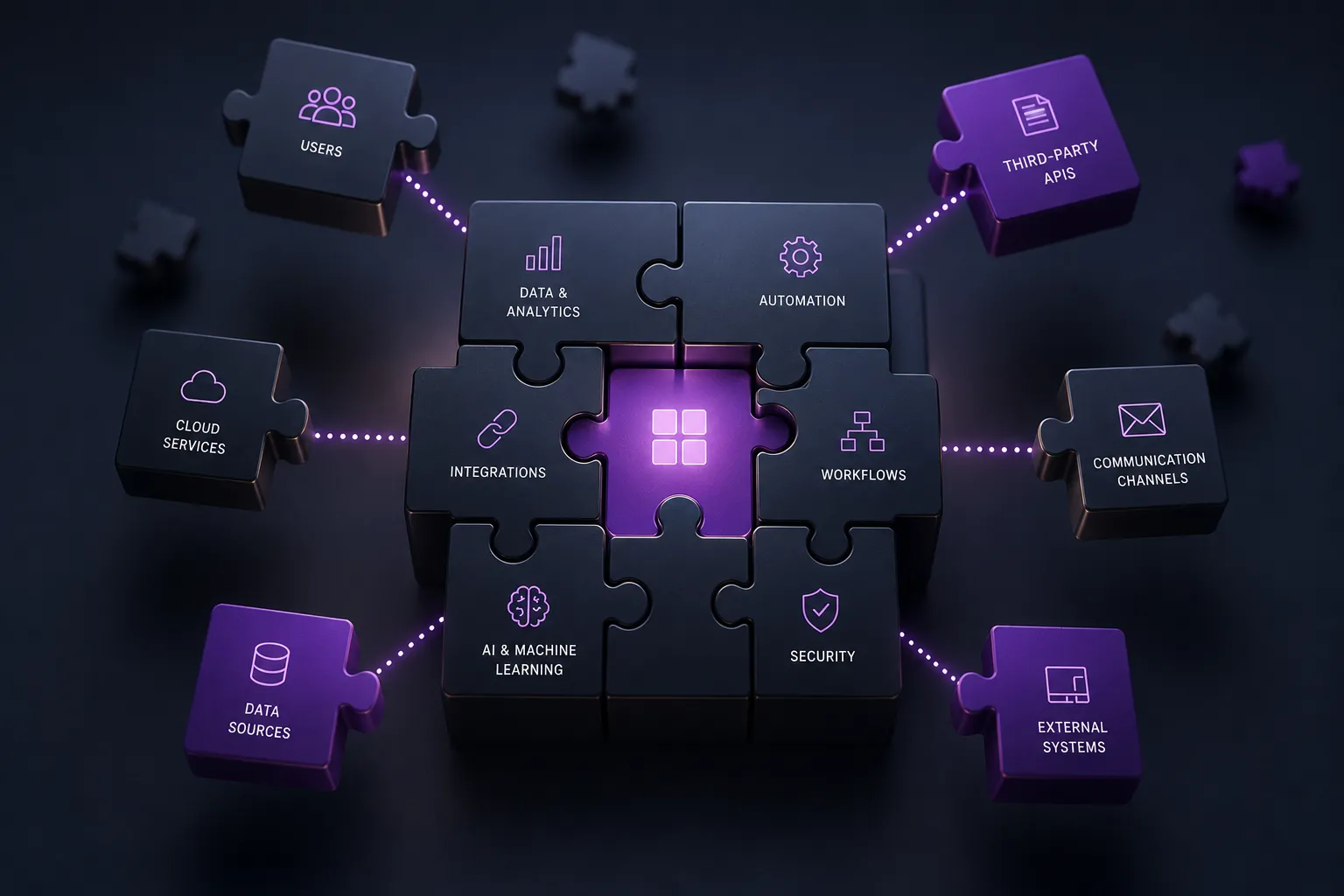
Top Features of a Modern Enterprise Portal in 2026
Most companies rely on multiple systems for HR, finance, communication, and customer support. While these tools help teams operate, they also create disconnected workflows, slow down collaboration, and make information harder to access.
This is why businesses are rethinking what is an enterprise portal and the value it brings to everyday operations. Modern enterprise portals connect tools, data, and workflows in one place, helping organizations reduce manual work, improve efficiency, and create a smoother digital experience for employees and customers alike.
Why enterprise portals are becoming critical in 2026?
As enterprises grow, the gap between systems and execution becomes more expensive. Teams operate across multiple tools, approvals slow down workflows, and data moves with delays instead of in real time. This directly impacts revenue cycles, increases operational costs, and limits the ability to scale efficiently.
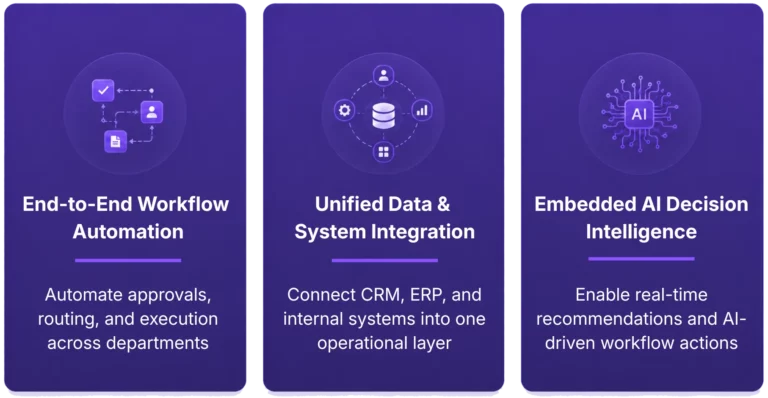
That is why an enterprise portal solution is becoming a critical layer in 2026 – not as another interface, but as a system that connects processes, reduces friction, and improves execution speed across the business. Key business drivers behind this shift:
- increasing operational complexity that slows down cross-team execution;
- high cost of manual processes and approvals in day-to-day operations;
- lack of real-time visibility into workflows, performance, and bottlenecks;
- fragmented data across CRM, ERP, and internal systems;
- growing need to scale operations without increasing headcount.
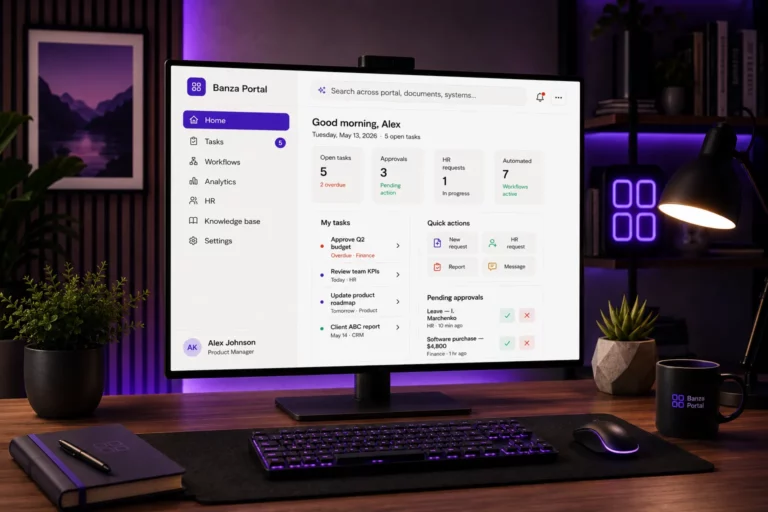
Here’s a real-world example. One of Ukraine’s largest banks implemented modern enterprise portal software with Banza ePortal to centralize employee access and automate internal workflows. As a result, the company automated 7 workflows in a single portal, created a unified knowledge hub, and saved around $200,000 annually compared to SharePoint solutions. The portal helped modernize digital operations, improve employee experience, and simplify access to internal services and information across the organization. Download the full case study to explore the implementation approach and business results in more detail.
What is a modern enterprise portal (and how it’s different from outdated systems)?
A modern enterprise web portal is not just a centralized access point, but an operational layer where workflows, data, and decisions are executed in real time. Instead of acting as a gateway to systems, it becomes the environment where work actually happens – connecting users, processes, and business logic into a single, coordinated flow.
Insight: Most enterprises don’t lack systems – they lack execution across them. Modern portals create value not by connecting tools, but by enabling real-time actions inside workflows.
|
Function |
Legacy intranet / outdated systems |
Modern enterprise portal |
| Content delivery | Static pages identical for all users | Real-time content, personalized based on role, context, and current tasks |
|
System interaction |
Links to external tools and manual navigation |
Direct interaction with CRM, ERP, and workflows inside one interface |
| Workflow execution | Manual approvals, emails, and fragmented processes | Automated workflows with real-time execution and task orchestration |
|
Data usage |
Disconnected data across multiple systems | Unified data with real-time synchronization and contextual access |
|
Search capabilities |
Basic keyword search | AI-driven search with natural language understanding and intent detection |
| Decision-making | Requires manual analysis and coordination | Built-in decision intelligence and next-best-action recommendations |
| User experience | Fragmented, multiple logins and systems | Single environment with seamless access to all services and actions |
| Scalability | Growth requires more people and coordination | Scales operations through automation without increasing headcount |
Core features of a modern enterprise portal
Not all portals deliver measurable business impact. The difference between basic tools and systems that actually improve operations lies in how they support execution, decision-making, and scalability. Modern enterprise portal features are designed not just to provide access, but to reduce operational costs, accelerate workflows, and enable consistent performance across departments. Below are the core capabilities that define a high-performing enterprise portal platform in 2026.
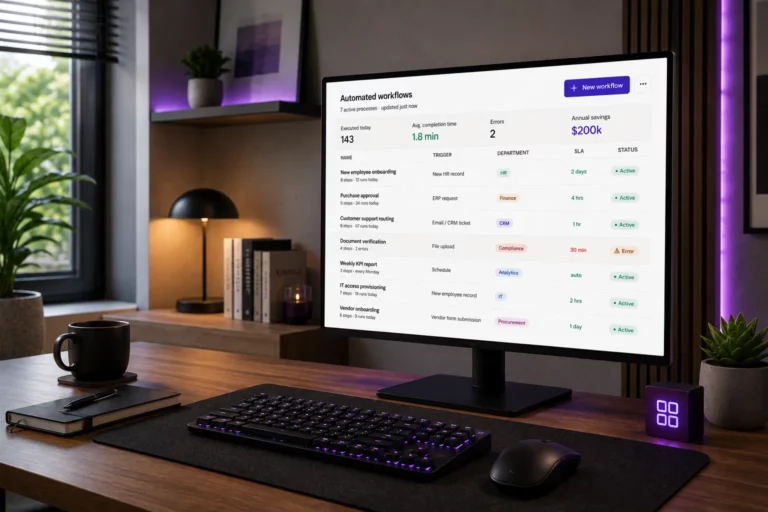
Embedded AI agents within business workflows
In many enterprises, critical processes still rely on manual steps – document checks, approvals, and customer interactions – which slow execution and increase error rates. Embedded AI agents eliminate these bottlenecks by operating directly inside workflows, automating routine tasks and triggering actions in real time.
As part of modern enterprise portal software, they handle document validation, case routing, and first-line support, reducing manual workload and accelerating execution. The result is faster processes, lower operational costs, and the ability to scale without expanding teams.
Real-time decision intelligence and next-best actions
Most enterprise teams have access to data, but not to timely decisions. Reports and dashboards create delays, forcing teams to act after problems occur. A modern portal closes this gap by embedding decision intelligence into workflows, enabling systems to analyze data and recommend next-best actions in real time. Within an enterprise portal platform, this allows teams to respond faster, prevent risks earlier, and maintain consistent performance without manual coordination.
End-to-end workflow automation and orchestration
In many enterprises, workflows break down at handoffs between teams, where tasks are delayed, duplicated, or lost entirely. End-to-end automation eliminates these gaps by orchestrating processes across departments, ensuring that every step – from request to completion – is executed without manual coordination.
As part of an enterprise portal solution, this enables automatic task routing, SLA control, and real-time status tracking, reducing cycle times and operational overhead. The business impact is clear: fewer bottlenecks, more predictable execution, and the ability to scale complex processes without increasing management effort.
Unified data layer with contextual access
A common challenge in enterprise environments is fragmented data spread across multiple systems, forcing teams to make decisions based on incomplete or outdated information. A unified data layer solves this by synchronizing data in real time and presenting it within the context of each workflow.
Through enterprise system integrations, a modern portal connects CRM, ERP, and other systems into a single source of truth, where users see only the data relevant to their role and task. This reduces errors, improves decision accuracy, and eliminates time spent searching for information, directly increasing operational efficiency.
No-code configuration for rapid process adaptation
In many enterprises, even small process changes require IT involvement, creating delays and increasing costs. No-code configuration removes this dependency by allowing business teams to adapt workflows, forms, and logic without development cycles. Within an enterprise digital platform, this enables faster response to market changes, regulatory updates, or internal needs without disrupting operations. The result is shorter implementation cycles, reduced IT workload, and greater agility in scaling and optimizing business processes.
Enterprise-grade security and role-based governance
As operations scale, uncontrolled access to data and workflows becomes a critical risk. Enterprise-grade security ensures that every action and data point is controlled and traceable. A modern portal enforces role-based access, audit logs, and compliance rules across all workflows, reducing the risk of errors, data breaches, and regulatory issues. This becomes even more important as organizations adopt enterprise experience platform capabilities, where secure and personalized access directly impacts both efficiency and trust.
Scalable architecture for cross-department operations
Many organizations struggle to scale because processes are built for individual teams, not for the business as a whole. A scalable portal architecture connects workflows across departments, enabling consistent execution without adding complexity.
This approach is reflected in leading enterprise information portal examples, where HR, finance, operations, and customer-facing teams operate within a unified system. The business impact is the ability to handle higher volumes, expand operations, and maintain performance standards without increasing coordination overhead or operational costs.

What problems a modern portal actually solves?
A modern portal addresses key operational gaps that directly impact execution speed, cost, and scalability across the business. The key operational problems a modern portal solves:
- fragmented workflows across multiple systems that slow down execution;
- manual approvals and handoffs that increase cycle times and errors;
- lack of real-time visibility into processes, bottlenecks, and performance;
- duplicated data and inconsistent information across departments;
- high dependency on human coordination for routine operations.
Insight: Most operational inefficiencies are not caused by a lack of tools, but by how those tools are used together. Adding more systems often increases complexity instead of solving it. Real improvement comes from restructuring execution, not expanding the tech stack.
Enterprise portal vs multiple disconnected tools
Most enterprises don’t lack tools – they lack coordination between them. As systems grow, execution slows down, costs increase, and visibility decreases, making it harder to scale operations efficiently. The difference becomes clear when comparing how disconnected tools operate versus a unified portal approach.
|
Aspect |
Multiple disconnected tools |
Enterprise portal |
|
Workflow execution |
Manual handoffs between systems, delays and errors |
End-to-end workflows executed within one system |
|
Data consistency |
Duplicate and inconsistent data across platforms |
Unified data with real-time synchronization |
|
Decision-making |
Based on delayed reports and manual analysis |
Real-time insights and next-best actions inside workflows |
|
Operational speed |
Slowed by switching between tools and approvals |
Faster execution with automated routing and actions |
|
Visibility |
Limited view of processes and bottlenecks |
Full visibility across workflows and performance |
|
Scalability |
Requires more people to manage growing complexity |
Scales operations without increasing headcount |
|
Integration |
Point-to-point integrations with limited coordination |
Centralized enterprise system integrations enabling seamless execution |
|
User experience |
Fragmented interfaces and multiple logins |
Single environment for all tasks and interactions |
How to understand if your business needs an enterprise portal?
If your teams rely on multiple systems, manual coordination, and constant follow-ups to complete routine tasks, it’s a clear signal that your current setup is limiting efficiency. Delays in approvals, duplicated data, lack of visibility into workflows, and increasing operational costs are all indicators that processes are not scaling effectively. A modern portal becomes necessary when growth starts to depend on adding more people instead of improving execution, helping standardize workflows, reduce manual effort, and enable consistent performance as the business expands.
What to consider before building an enterprise portal?
Before building a portal, enterprises should focus not on the interface, but on the processes it needs to improve. The biggest risk is replicating existing inefficiencies in a new system instead of redesigning how work is executed. It’s critical to identify high-friction workflows, define clear business outcomes (such as reducing cycle time or operational costs), and ensure strong integration with core systems. Without this foundation, even the most advanced portal becomes another layer of complexity rather than a driver of efficiency and scalability.
How to approach enterprise portal development in 2026?
In 2026, portal development should focus on improving execution, not just building an interface. Start with high-friction workflows, integrate core systems, and embed automation where it delivers immediate business impact. A phased approach reduces risk and helps achieve faster results. If your operations still depend on manual coordination, a consultation with Banza can help identify where a modern portal will bring the most value first.
Modernize Enterprise Operations with AI
Streamline workflows, integrate systems, and enable real-time execution
Explore AI Solutions