
What Is an AI Workforce and How Does It Work in Practice?
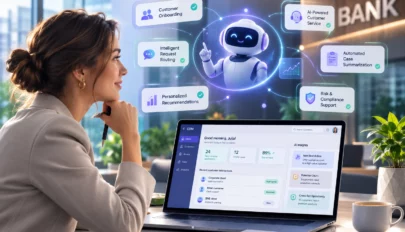
An AI workforce is not a group of robots replacing people. In business, it means a system of AI agents, automated workflows, and digital tools that support human teams in daily operations.
For companies, the value is practical: fewer repetitive tasks, faster decisions, better customer experience, and more control over processes. This is why the topic of AI and workforce is becoming important not only for technology teams, but also for executives, operations leaders, sales directors, and customer service managers.
At Banza, we build no-code and AI-native solutions that help companies use automation where it creates measurable business value. As a TOP partner of Creatio and Global System Integrator 5th level since 2018, we help enterprise clients turn AI, CRM, and workflow automation into working business systems.
What is an AI workforce in practical terms?
An AI workforce is a digital layer that helps employees complete work faster and with fewer manual steps. It can include AI agents, CRM workflows, document processing, call analytics, customer service automation, and business process orchestration.
In simple terms, an AI workforce helps answer three business questions:
- What task should be done next?
- Who or what should handle it?
- How can the process move forward without manual delay?
An AI worker or AI employee is not a person. It is a software agent designed to perform a specific business role. For example, it can analyze a customer call, check a document, classify a support request, summarize information, or route a case to the right team.
What does “AI-native” mean?
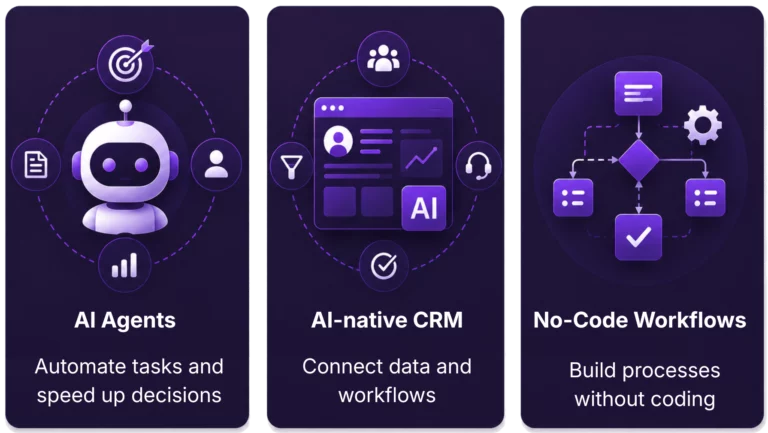
AI-native means that AI is built into the logic of the platform, not added as a separate tool. It can work inside sales, service, marketing, and operations, where real business processes happen.
Creatio is an agentic CRM and no-code workflow automation platform. It combines CRM, AI agents, and workflow tools so companies can build processes faster and adapt them without long development cycles.
What does “no-code” mean?
No-code means that workflows, business applications, and process logic can be configured visually, without extensive programming. This matters because business teams often need changes faster than traditional development can deliver.
For example, a company can adjust approval rules, add a new service workflow, change a sales process, or launch an internal automation scenario without building everything from scratch.
How AI workforce works inside modern companies
An AI workforce works best when it is connected to real business processes. It should not live outside CRM, service tools, or operational systems. It should help teams inside the tools they already use to sell, serve customers, manage tasks, and control performance.
In practice, digital workforce AI can support a company in several ways:
- analyze incoming requests and identify intent;
- create tasks or cases automatically;
- summarize calls, emails, and documents;
- validate data before it moves to the next stage;
- suggest the next best action for a manager;
- route requests to the right employee or team;
- monitor workflow progress and highlight delays;
- prepare insights for managers.
This is where Creatio’s agentic CRM approach becomes valuable. AI agents can be embedded into business workflows, while Creatio CRM, Creatio Sales, Creatio Marketing, Creatio Service, and Creatio Studio help connect customer data, process logic, and team actions in one environment.

AI workforce vs traditional automation
Traditional automation follows fixed rules. It works well when a process is predictable: if a customer submits a form, create a task; if a deal reaches a stage, send a notification; if an invoice is approved, move it to the next step.
An AI workforce can support more flexible scenarios. It can work with context, text, calls, documents, and customer history. This is important when a task cannot be solved only by a simple “if-this-then-that” rule.
| Business need | Traditional automation | AI workforce |
| Repetitive task execution | Strong fit | Strong fit |
| Simple notifications | Strong fit | Strong fit |
| Text analysis | Limited | Strong fit |
| Call summaries | Limited | Strong fit |
| Document review support | Limited | Strong fit |
| Case classification | Basic rules | Context-based logic |
| Customer service support | Process routing | AI-assisted service |
| Management insights | Reports | Reports plus AI recommendations |
The point is not to choose one approach forever. In many companies, the best result comes from combining workforce automation with AI agents. Classic workflows create structure. AI agents add context and decision support.
Real examples of AI workforce in business
AI workforce becomes easier to understand through practical scenarios.
Sales teams
Sales managers often lose time on preparation, notes, follow-ups, and CRM updates. AI can analyze calls, summarize key points, and help managers understand what should happen next.
For example, Banza’s Call Insight Agent can support teams that need better visibility into customer conversations, call quality, and sales communication.
This type of AI automation in business helps managers spend less time on routine analysis and more time on high-value conversations.
Document-heavy operations
Many companies work with contracts, forms, customer documents, invoices, claims, or partner files. Manual checking takes time and increases the risk of errors.
A Doc Validator Agent can help review documents, detect missing data, and support teams that need faster and more consistent validation.
This is especially useful in industries where speed and accuracy directly affect customer experience.
Customer service teams
Support teams handle many repeated questions, urgent cases, complaints, and status requests. When every request is sorted manually, response time grows and employees become overloaded.
A Support Agent can help classify requests, prepare context, route cases, and support service teams during high-load periods.
This is a practical example of AI agents for business: they do not remove human responsibility, but help teams process more work with better structure.

What problems AI workforce solves
Companies usually do not need AI just because it is a trend. They need it when existing processes become too slow, expensive, or difficult to scale.
An AI workforce can help solve several common problems.
Too much manual work
Employees often repeat the same actions every day: copy data, check fields, create tasks, search for information, write summaries, or send standard updates.
AI and no-code workflows can reduce this load and help teams focus on work that requires judgment.
Slow customer response
When customer requests move through email, chats, spreadsheets, and CRM separately, service becomes slower. AI agents can classify requests, prepare summaries, and trigger the right workflow faster.
Fragmented data
If sales, service, and operations work in separate systems, managers do not see the full picture. AI-native CRM helps connect customer history, tasks, cases, and workflows.
Difficult process changes
Traditional development can take too long for everyday operational changes. No-code tools help companies adapt faster and reduce dependence on large development cycles.
Lack of visibility
Executives need to know where processes slow down, which teams are overloaded, and which tasks create unnecessary costs. AI workforce management helps turn daily operations into measurable workflows.
Common fears about AI replacing people
One of the biggest questions is: how will AI affect the workforce?
The realistic answer is that AI will change many roles, but not every role in the same way. In most enterprise scenarios, AI works best as an assistant, analyst, validator, or workflow participant. It helps people process information faster and make fewer manual mistakes.
The concern about AI replacing humans in the workforce is understandable. But for many companies, the immediate business problem is different: teams are overloaded, processes are slow, and skilled employees spend too much time on repetitive work.
AI can help people do more valuable work by taking over tasks such as:
- preparing summaries;
- checking standard data;
- routing requests;
- finding repeated issues;
- updating workflow steps;
- supporting first-line service;
- providing context before decisions.
The goal is not to remove people from business processes. The goal is to give employees better tools and make processes more scalable.
AI for future workforce: what companies should prepare for
AI for future workforce planning should start with processes, not with technology. Before choosing tools, leaders should understand which tasks create delays, where teams spend too much time, and which operations affect revenue or customer satisfaction.
A practical roadmap can include:
- Identify repetitive and high-volume processes.
- Define where AI can support decisions or analysis.
- Connect AI agents to CRM and workflows.
- Start with one measurable use case.
- Train teams to work with AI tools.
- Expand automation after the first results are clear.
This approach reduces risk. The company does not try to transform everything at once. It builds a controlled AI workforce step by step.

How Banza helps companies build AI workforce solutions
Banza develops no-code, AI-native CRM and workflow automation solutions for enterprise companies. We work with Creatio as an agentic CRM and workflow platform, helping clients connect sales, marketing, service, and operations into one business environment.
Our role is not only technical implementation. We help clients understand which processes should be automated, how AI agents can support teams, and how to launch changes faster.
We support companies with:
- business process analysis;
- Creatio implementation and customization;
- no-code workflow design;
- AI agent integration;
- CRM and service automation;
- document and call processing scenarios;
- integrations with existing systems;
- user adoption and support after launch.
Banza has a team of 150+ professionals, its own R&D center, an applications marketplace, and experience with 200+ companies worldwide. We also bring strong expertise in banking, insurance-related processes, telecom, retail, logistics, manufacturing, and enterprise service automation.
Why fast time-to-market matters
AI workforce projects should not take years to prove value. Companies need to see whether automation reduces manual work, improves speed, and supports business growth.
No-code and AI-native tools help shorten the path from idea to working solution. Banza focuses on fast time-to-market, flexibility, and scalability, so the solution can grow with the client’s business needs.
This is especially important for enterprise companies that need to modernize operations without creating heavy dependency on internal IT resources for every process change.
When your company may need an AI workforce
A business should consider an AI workforce if it faces several of these signs:
- employees spend too much time on repetitive tasks;
- customer requests are processed too slowly;
- managers lack clear visibility into operations;
- documents are checked manually and inconsistently;
- call quality is hard to analyze at scale;
- support teams are overloaded;
- workflows depend on individual employees;
- process changes take too long;
- customer data is fragmented across systems.
In these cases, AI workforce is not a futuristic idea. It is a practical way to improve how the company works today.
An AI workforce does not replace business strategy, strong teams, or process discipline. It supports them. When AI agents, CRM, and workflow automation are connected correctly, companies can reduce routine work, speed up operations, and create a more scalable model for growth.
If your company wants to stay competitive with AI-native CRM, no-code workflows, and practical AI agents, contact Banza. We will help you identify the right use cases, design a clear automation scenario, and build a solution that supports real business results.