Insurance Automation: How AI and Workflow Automation Transform Claims and Underwriting
Insurance companies continue to face growing operational pressure as claims volumes increase, underwriting processes become more complex, and customer expectations shift toward faster digital service. These challenges are driving greater adoption of insurance automation solutions that help insurers streamline operations and improve service delivery.
However, many insurers still rely on fragmented systems, manual reviews, and disconnected workflows that slow down claims handling and operational decision-making. This is why insurance automation is becoming essential for improving operational efficiency, reducing delays, and scaling insurance operations through connected AI-driven workflows.
Why insurance operations are still slowed down by manual processes
Despite ongoing insurance digital transformation initiatives, many insurers still depend on fragmented operational workflows, manual reviews, email-based coordination, and disconnected legacy systems. As claims volumes, policy servicing demands, and underwriting complexity continue to grow, insurers often struggle to scale operations without increasing administrative workload and processing delays.
The most common operational bottlenecks include:
- manual claims intake and document verification processes;
- disconnected systems across underwriting, claims, servicing, and customer communication;
- repetitive data entry across multiple operational platforms;
- slow approval cycles for claims, renewals, and risk assessment decisions;
- limited visibility into claim status, workload distribution, and SLA performance;
- inconsistent customer communication during claims and servicing processes;
- operational delays caused by manual routing and cross-department coordination.
Insight: In many insurance organizations, operational inefficiencies are no longer caused by a lack of data, but by disconnected workflows and fragmented execution. This is why insurance workflow automation is becoming critical for insurers that want to improve coordination, reduce delays, and scale operational processes more efficiently.
What insurance automation actually means today
Modern insurance automation is no longer limited to digitizing documents or reducing paperwork. This is especially important for property and casualty insurers, which often manage complex policy, claims, and approval workflows.
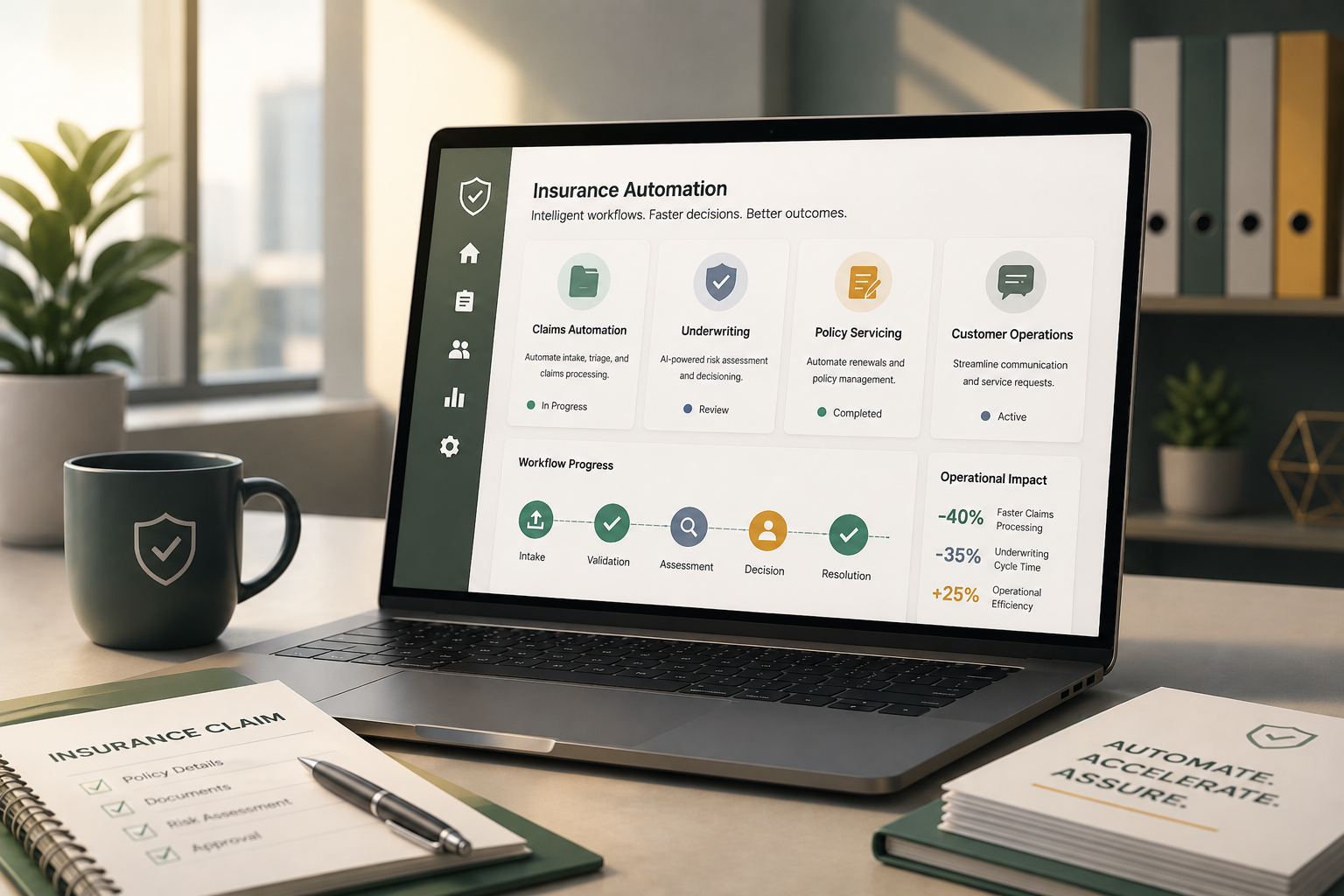
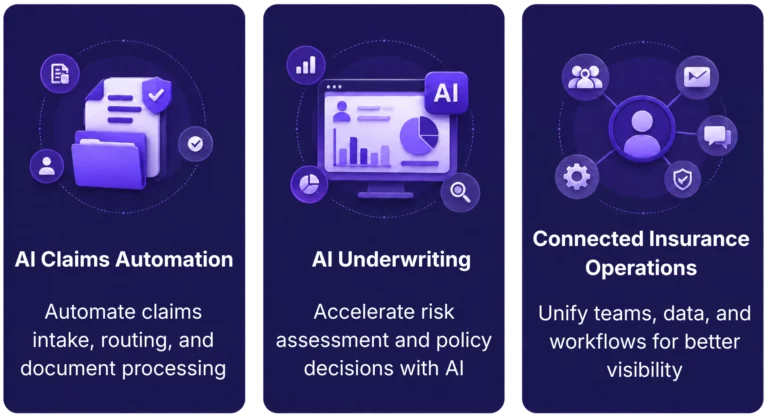
Today, AI for insurance is increasingly focused on connected workflows, workflow orchestration, and automated decision support that streamline claims processing, policy servicing, approvals, and internal coordination across the insurance lifecycle.
Insurance automation typically includes:
- automated claims intake, routing, and document validation;
- AI-assisted risk evaluation and policy review;
- centralized visibility across claims, servicing, and customer communication;
- automated SLA tracking, approval routing, and escalation management;
- OCR and intelligent document processing for insurance data extraction;
- workflow-based coordination between brokers, adjusters, and service teams;
- real-time operational analytics that help identify operational bottlenecks earlier.
Today, insurance and artificial intelligence are increasingly connected through operational execution rather than isolated AI tools. This is why many insurers are adopting insurance automation software that combines AI, workflow orchestration, and centralized operational management inside a unified environment.

How AI transforms insurance claims processing
Claims operations remain one of the most resource-intensive areas in insurance, especially when teams rely on manual reviews, fragmented communication, and repetitive administrative tasks. These issues are particularly common for auto insurers, where high claims volumes require fast and consistent processing.
AI helps insurers accelerate claims handling, improve decision consistency, and reduce delays across the entire claims lifecycle.
AI transforms insurance claims processing through:
- automated FNOL intake and intelligent claims routing;
- OCR-based extraction and validation of claims documents, forms, and supporting files;
- automated insurance claims workflows that reduce manual data entry and repetitive administrative work;
- real-time fraud detection and risk scoring based on claim patterns and behavioral signals;
- automated claims processing insurance systems that support faster claim assessment and approval workflows;
- centralized visibility into claim status, workloads, SLA performance, and operational bottlenecks;
- AI-generated summaries and recommendations that help adjusters review cases more efficiently.
As claims volumes continue to grow, insurers are increasingly embedding AI directly into claims operations instead of relying on disconnected automation tools. This allows teams to improve processing speed, maintain operational consistency, and scale claims handling without increasing administrative overhead.
How automated underwriting improves efficiency and decision-making
Insurance teams often spend significant time reviewing applications, validating documents, and coordinating approvals across multiple systems and departments. For life insurance companies, underwriting workflows often involve extensive documentation and multiple approval stages.
As submission volumes grow, manual risk evaluation slows down decision-making, increases operational costs, and creates inconsistencies across policy approval processes.
Automated insurance underwriting improves operational efficiency through:
- AI-assisted risk evaluation based on customer, policy, and historical claims data;
- automated extraction and validation of application and policy information;
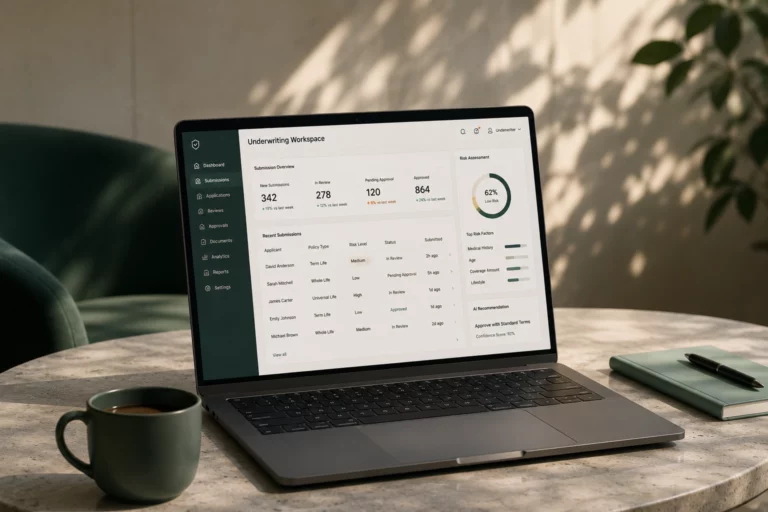
- centralized visibility into submissions, approvals, and pending reviews;
- automated routing of applications based on risk level, policy type, and internal rules;
- faster identification of incomplete, inconsistent, or high-risk submissions;
- real-time recommendations that support more consistent underwriting decisions;
- reduced manual coordination between brokers, analysts, and approval teams.
Modern AI underwriting workflows help insurers process larger submission volumes without increasing administrative workload. Instead of relying on fragmented manual reviews, insurers can improve decision consistency, accelerate policy approvals, and maintain greater operational control across policy evaluation processes.
Insurance companies that successfully scale claims and underwriting operations move beyond isolated automation and build connected operational environments across customer service and policy operations. With Banza automated insurance agent, insurers can automate claims routing, policy reviews, approvals, and customer communication inside a unified AI-driven workflow ecosystem. See how insurance companies automate claims, underwriting, and customer operations with AI-powered workflows.
Why workflow automation is critical for insurance operations
Insurance operations involve constant coordination between claims teams, policy servicing, brokers, analysts, customer support, and compliance departments. For insurance brokers and agencies, maintaining visibility across client pipelines and renewals is often a major operational challenge.
When these processes rely on emails, spreadsheets, and manual approvals, operational delays quickly accumulate across the entire insurance lifecycle.
Insurance workflow automation improves operational execution through:
- automated task routing between claims, servicing, and approval teams;
- centralized tracking of SLA deadlines, approvals, and operational status;
- faster escalation management for high-priority or delayed cases;
- standardized workflows that reduce inconsistencies across insurance operations;
- automated notifications and internal coordination across departments;
- reduced dependency on manual follow-ups and repetitive administrative tasks;
- improved visibility into workloads, bottlenecks, and process performance.
As insurers continue scaling operations, workflow automation becomes critical not only for efficiency, but also for operational consistency and service quality. This is why many companies combine AI, workflow orchestration, and robotic process automation in insurance to improve execution speed and reduce operational friction across departments.
How AI and automation improve customer experience in insurance
Customer expectations in insurance continue to shift toward faster responses, transparent communication, and more consistent digital interactions across claims and policy servicing processes. However, fragmented systems and manual coordination often create delays, communication gaps, and inconsistent customer experiences.
AI and automation improve customer experience in insurance through:
- faster response times during claims handling and policy servicing;
- automated status updates and notifications across customer communication channels;
- centralized customer history that improves continuity between support and operational teams;
- AI-driven routing that connects customers with the right specialists faster;
- reduced delays caused by manual approvals and fragmented internal coordination;
- more accurate handling of customer requests, policy updates, and service inquiries;
- consistent communication across claims, servicing, and renewal workflows.
Modern insurance AI solutions help insurers maintain service quality while scaling operations and handling larger customer volumes. Instead of relying on disconnected communication processes, insurers can deliver faster, more transparent, and more predictable customer experiences across the entire policy lifecycle.

The role of AI-native CRM and workflow platforms in insurance automation
Many insurers already use multiple systems for claims management, policy servicing, customer communication, and operational reporting. However, disconnected platforms often create duplicated data, inconsistent workflows, and limited visibility across insurance operations.
AI-native CRM and workflow platforms improve insurance operations through:
- centralized visibility across claims, customer communication, servicing, and operational activities;
- connected workflows that reduce delays between departments and approval stages;
- unified customer and policy data inside a single operational environment;
- real-time coordination between brokers, adjusters, analysts, and service teams;
- automated tracking of claims status, approvals, SLA deadlines, and operational bottlenecks;
- configurable no-code workflows that adapt to changing insurance processes faster;
- embedded AI-driven recommendations that support operational decision-making.
Instead of operating as isolated systems, modern insurance platforms are becoming connected execution environments that combine AI, workflow orchestration, and operational visibility inside a unified ecosystem. This allows insurers to scale operations more efficiently while maintaining process consistency and greater control across insurance workflows.
How insurers can build scalable automated operations
Building scalable insurance operations requires more than introducing isolated automation tools into existing workflows. Insurers need connected operational processes, centralized data visibility, and coordinated execution across claims handling, policy servicing, approvals, and customer communication.
To build scalable automated operations, insurers should:
- identify operational bottlenecks that create delays across claims and policy workflows;
- connect claims, servicing, communication, and reporting systems into a unified operational environment;
- automate repetitive administrative tasks that slow down execution and increase manual workload;
- standardize approval flows, escalation rules, and internal coordination processes;
- implement AI-driven routing and operational monitoring for high-volume insurance activities;
- continuously analyze workflow performance, SLA compliance, and operational efficiency metrics;
- scale automation gradually by prioritizing high-impact operational use cases first.
As insurance operations become more complex, scalable automation depends on how effectively insurers connect workflows, teams, and operational data across the organization. Automate claims and underwriting with AI and see how Banza helps insurers improve execution speed, reduce operational friction, and build scalable insurance operations through connected workflow automation.