
Measuring ROI of AI Chatbots in Large Organizations
Large organizations handle thousands of customer calls every day. These can be support requests, product questions, order status, or technical assistance. In the traditional model, this requires large teams of operators, supervisors, and managers, which creates high operational costs. That is why AI chatbots have become an important tool for optimizing business processes.
Modern platforms, such as the chatbot builder from BanzaIT, allow you to create intelligent assistants without programming and integrate them into CRM, messengers, and internal company systems. This allows you to automate customer service, improve response speed, and reduce costs. But the main question for large organizations is how to correctly measure the ROI of a chatbot and understand its real business value.


What Chatbot ROI Really Means for Large Organizations
It is a common mistake to think about chat ROI as a financial indicator that shows the ratio of costs and revenues. For big companies, it is much more than that – it is a measure of automation effectiveness that shows how impactful the chatbot is for operational processes, service quality, and team productivity.
Big companies can take a lot of benefits from a chatbot as it can perform a number of functions at once. It can answer common questions, process requests, send messages, and help customers choose a proper product in accordance with their demands or with processing register requests in CRM. It reduces the workload on operators and makes sure that the support is constantly available.
ROI also includes indirect benefits:
- Faster responses increase customer satisfaction.
- Automatic data collection – allows you to better understand the needs of the audience.
- Companies can scale support without a proportional increase in staff.
In large organizations, a chatbot becomes part of the digital infrastructure, and not just a tool for automatic responses. It integrates with CRM, analytics, databases, and business processes, allowing you to create a single system of interaction with customers.
In our recent work, we integrated AI agents into a client’s Creatio CRM ecosystem to automate the entire lifecycle of customer inquiries. Just like the Global Survey Report on the State of AI Agents & No-Code says, it leads to incredible operational changes in a positive sense:
- Workflow Autonomy. AI agents now handle complex, multi-step triage, reducing the need for manual intervention in 90% of routine cases.
- Supervisory Leap. By automating quality control and dialogue verification, the organization achieved a 50% reduction in call center supervisors’ manual workload, exactly as highlighted in Creatio’s latest industry research.
- Operational Scalability. The system, built on Creatio no-code CRM, allows the client to scale their support capacity during peak seasons without a proportional increase in headcount, maximizing their long-term ROI.
This aligns with the broader market trend where enterprise CRM platforms, particularly Creatio AI-native CRM, are becoming the backbone of scalable digital infrastructure.
Key Cost Components of Chatbot Investment
The company should accurately capture ROI, and to do that, it is important to understand the cost structure of a chatbot. Costs vary depending on how big the company is, how complex the scenario is, and the level of integration. Among the key aspects that form the cost:
- Chatbot platform license or subscription.
- Integration with CRM and internal systems.
- Configuring interaction scenarios and logic.
- Integration with messaging apps such as Telegram, WhatsApp, or Viber.
- Staff training.
- System support and updates.
Businesses use Banza’s no-code chatbot builder to reduce a major part of the development costs, as there is no longer a need to build a system from scratch. A visual designer allows marketers and managers to create and modify scripts themselves through an intuitive drag-and-drop interface
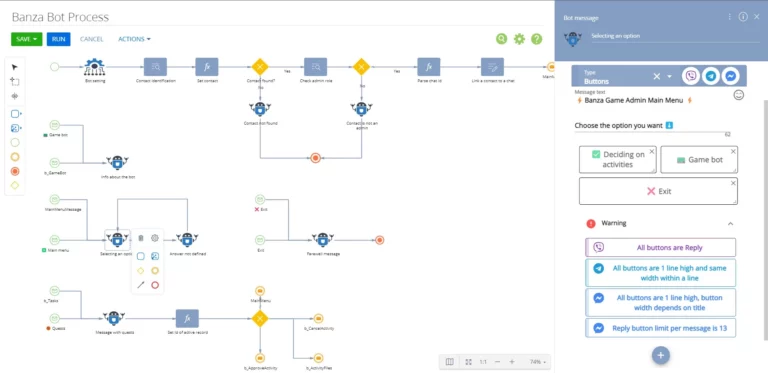
Managing complex interaction logic is simplified with Banza’s visual no-code designer. This approach ensures that any organization can scale its digital assistant’s capabilities without involving expensive development resources.
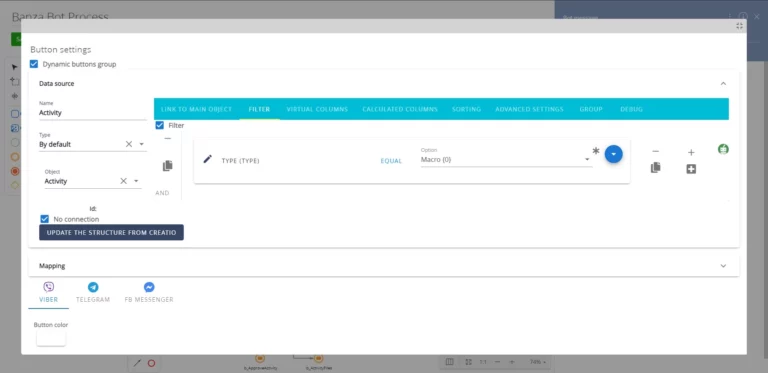
Seamlessly connecting AI agents to the Creatio ecosystem via Banza’s platform.
How to Use a Chatbot Cost Calculator for ROI Estimation
The chatbot cost calculator is a tool you need to use if you want to understand how much money you are going to save thanks to the implementation of a chatbot, based on specific business data and real operational indicators. The main function is to show how customer support costs change after the implementation of automation, and how quickly the investment in this bot pays off. This is very important for big companies, since even a small increase in efficiency can lead to worthwhile savings across all sectors of the company.
Such a calculator allows you to compare two models of work: traditional, where all requests are processed by people, and automated, where part of the requests are processed by a chatbot. As a result, the company can see not only a direct reduction in costs, but also improvements in productivity, speed of processing requess, and efficiency of personnel use. This helps to make informed decisions about the implementation of chatbots and budget planning.
Few parameters are used to calculate ROI:
- The number of customer requests per day, week, or month.
- The average time for processing one request by an operator.
- The average cost of an operator’s hour or the full cost of processing one request.
- Percentage of calls that the chatbot can handle without human intervention.
- Cost of the chatbot platform, including license or subscription.
- Implementation, integration, and configuration costs.
- Support, upgrade, and optimization costs.
- Growth rates or seasonal fluctuations in the number of calls.
There are also a couple of factors that are considered indirect, but they are worth noting as well: reducing customer waiting times, reducing staff workload, and the ability to scale support without hiring new workers. To understand how it works, just imagine a company that receives 10 000 calls per month and a chatbot that automatically handles 60% of them. This means that only 4000 calls will require operator intervention. As a result, the load on the support team is reduced. The company can either reduce support costs or use the freed-up resources to improve service quality, customer service, or develop new areas.
Another important advantage of using the ROI calculator is the ability to predict future results. A company can simulate different scenarios, like the situation when the number of calls increases by 20%, or if the chatbot’s efficiency increases after optimizing the scripts. This opens doors for strategic planning of support development and the ability to avoid overloading staff.
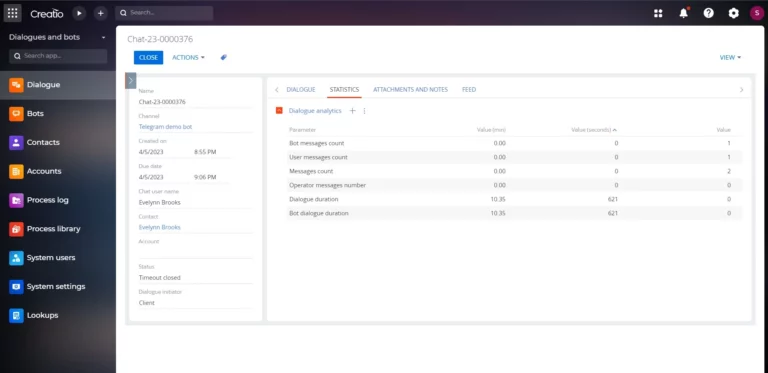
Our chatbot builder makes this approach even better thanks to built-in analytics and real-time data collection. The system automatically records the number of calls, the duration of dialogues, the frequency of script use, and the level of automation. This allows companies to obtain accurate data on the effectiveness of the chatbot and use it to calculate ROI without the need for manual data collection.
Practical Chat ROI Metrics Beyond Cost Savings
There should be no doubts about the importance of the cost savings, but chatbot ROI takes into account many other metrics that directly impact an organization’s performance. In big companies, the value of a chatbot is measured not only by reducing operating costs, but also by how it changes the speed of work, the quality of service, and the ability of the team to handle large volumes of requests without losing efficiency.
Important metrics include:
- Reduced customer response time.
- Increased number of requests processed.
- Increased customer satisfaction.
- Reduced workload on agents.
- Increased productivity of the support team.
- Increased number of completed requests.
Among the most important changes is how response time becomes faster. While previously it could have taken a while for a customer to receive at least some kind of response, a chatbot provides an instant response. This is very important for large organizations, where the speed of service directly affects the level of customer satisfaction and their loyalty. A quick response allows not only to resolve the problem faster, but also to reduce the number of repeated requests.
Chatbot makes the support service much more effective. One bot handles thousands of requests simultaneously, which would be an impossible task even for a team of professional operators. This allows a company to scale support without the need for a proportional increase in staff. Thanks to this fact, the organization can serve more customers with the same or even fewer resources.
Among other important factors is increased employee productivity. When a chatbot takes over the processing of typical requests, operators can focus on more complex and valuable tasks. This increases the efficiency of the entire team and allows for more rational use of specialists.
For us, the true value of an agentic CRM lies in its ability to liberate human talent. By delegating 90% of routine workflows to AI agents, organizations empower their teams with the «Freedom to Create» – adjusting the focus from data entry to high-value strategic decision-making and personalized customer engagement.
Take into consideration the quality of service. Chatbot works strictly to scenarios that were set by operators, and this is why it can deliver answers fast with high quality.
In an AI-native environment, operational excellence becomes the standard, not the goal. Unlike traditional systems, AI agents embedded into the CRM core ensure that business logic is executed with 100% consistency, eliminating human error and providing a predictable, high-quality service experience at any scale.
50% Reduction In The Call Center Supervisor’s Working Time to Improve the Quality of Customer Service
You should know about the results of optimizing the work of contact centers. The introduction of chatbots allows you to reduce up to 50% of the call center supervisor’s time, which was previously spent on quality control, dialog verification, and process management. This is made possible by automatic data collection, saving communication history, and built-in analytics, which allows you to quickly assess work efficiency and identify problem areas.
Instead of manually reviewing a large number of dialogs, supervisors can use analytical reports and metrics for decision-making. This significantly speeds up process management and allows you to focus on strategic tasks, such as improving service quality, optimizing internal procedures, and training staff. As a result, contact center management becomes more efficient and less labor-intensive.
Another important result is increased process transparency. The chatbot automatically saves all interactions, which allows you to analyze customer behavior, identify the most common problems, and improve interaction scenarios. This creates the basis for continuous service improvement based on real data, not assumptions.
In addition, chatbots work 24/7, without breaks or weekends. This means that customers can get help at any time, regardless of the company’s working schedule. Such availability significantly increases customer satisfaction and allows you to serve a global audience without the need to create night shifts or expand the staff.
In the long term, all these factors create a significant operational effect. Organizations can handle more calls, improve the quality of service, reduce staff workload, and optimize contact center management. It is these indirect but critical indicators that often form the bulk of the chatbot’s ROI and determine its strategic value to a large organization.
Common Mistakes in Measuring Chatbot ROI
Companies may have had misconceptions about how to use chatbot ROI, which leads to incorrect conclusions. This often happens because businesses are evaluating only direct financial advantages. Companies do not take into account indirect benefits, such as better user experience and improved team performance indicators.
Another mistake is taking a short-term approach. The ROI of a chatbot increases over time as the system accumulates data, optimizes, and becomes more efficient.
Another common problem is that the chatbot is not connected to the CRM or other business systems. When this happens, the bot works separately and cannot access customer data or help properly. Because of this, its usefulness is limited. It is also important to update and improve the bot regularly. If scripts and data are not reviewed and updated, the chatbot becomes less effective over time.
Best Practices for Maximizing Chatbot Investment Value
Every company can find a justification for chatbot investment, but it should be set properly and managed over time. Here is what to do:
- To deliver real business value, a chatbot should be deeply connected to the company’s CRM and internal systems. This allows it to see customer information and respond more accurately. Without this connection, the chatbot can only give general answers and may not be very useful.
- A powerful example of this is our Banza Chatbot for the Creatio CRM software. It acts as a native AI agent within the Creatio agentic CRM ecosystem, bridging the gap between customer communication and complex business processes. By leveraging Creatio’s no-code workflow platform, our solution doesn’t just provide answers, it triggers real-time updates in the Creatio AI-powered CRM (Sales and Service), orchestrating end-to-end workflows that traditionally required manual data entry.
- Companies should look at chatbot analytics regularly. Platforms like BanzaIT show how customers interact with the bot, what questions they ask, and where problems happen. This helps companies fix weak points and improve the chatbot step by step.
- Chatbots are best used for simple and repetitive tasks. For example, they can answer common questions, handle basic requests, and send updates to customers. This reduces the number of routine tasks employees have to do, so staff can focus on more complex issues.
Our chatbot is pretty smart to analyze the user’s activity and history of the chat to send different messages. It works pretty simply; if it sees the user for the first time, it is going to greet them as a new consumer and going to offer help. Returning customers receive additional information on what they were most interested in and get recommendations based on previous requests. It makes conversations more natural.
At the same time, companies should not expect chatbots to solve everything. A chatbot is just a tool, and it works best when combined with human support. It can handle routine communication, but employees are still needed for difficult or unusual situations.
A truly effective AI agent doesn’t just automate; it knows when to step back. In our ecosystem, the transition from an automated response to a live agent is handled through a seamless handover protocol:
- Smart Triggers. If a query is identified as high-priority or complex, the system flags it for human intervention.
- Real-time Agent Transfer. Within the Creatio workspace, the operator receives the full chat history. This ensures the customer doesn’t have to repeat themselves.
- Omnichannel Continuity. The operator picks up the dialogue directly from the agentic CRM interface, whether it started on Telegram or a website.
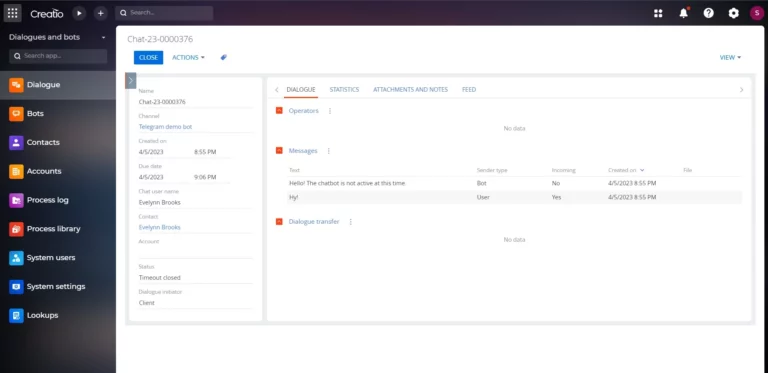
Unified agent workspace in Creatio showing dialogue history and transfer capabilities for seamless human-bot interaction.
In the long run, when you configure the chatbot the right way, it can become a normal part of everyday use in your company. It allows you to handle communication with your customers fast and without overload for your customer service team. But do not make a mistake about it – it still requires monitoring, updates, and improvements to remain useful.
Implementing AI agents and chatbots is an investment you make in your strategic advantage, which pays off not only in the numbers in the reports, but also in the loyalty of each client. At Banza, we help companies not just follow trends, but also get ahead of them. Our solutions based on no-code technologies and deep integration with Creatio allows your business to remain as competitive, flexible and efficient as possible in the market.
Do not put off efficiency for tomorrow. Contact us today, and we will help you calculate the potential ROI for your company and choose a solution that will take your service to the next level!